In January, the men's shows in Milan and Paris sent out suits. Not a suit as a joke, or one worn under a parka, but rows of them, with square shoulders, long jackets and trousers that fell straight to the shoe. The Impression called it a return "not seen since the streetwear takeover of the 2010s." Zegna cut the shoulder square and the jacket long. Saint Laurent went long and lean in black. Tom Ford made tailoring "the backbone of the collection."
By February the women's shows had followed. Saint Laurent opened with all-black trouser suits with strong shoulders, The Row went slim and precise, and Khaite put a sharp, almost military shoulder on everything dark.
To this reporter, every one of those reviews read like a description of a good lawyer walking into a courtroom. The suit the runway is selling for Fall 2026 is the suit a trial lawyer has worn for years. For the first time in a while, buying the current thing and buying the right thing are the same purchase.
What the jury sees
A jury does not read a suit. It reads the fit.
Jurors cannot name a lapel width or tell a $900 jacket from a $9,000 one. What they register in the first seconds is whether the clothes belong to the person wearing them. A jacket that pulls across the back when a lawyer lifts an exhibit, a sleeve that covers the hand, a trouser that puddles on the shoe: each suggests borrowed clothes, and borrowed clothes suggest uncertainty. A suit that sits on the shoulder and stays still while the lawyer moves is not noticed, and that is the goal. The jury should be watching the lawyer's face.
Simon Cundey of Henry Poole, who has cut suits on Savile Row for decades, said people find suits uncomfortable because "they don't fit." Fit is also where the money goes. Cloth, color and cut can be right at nearly any price.
One finding is not fair, but it is consistent. A 2025 Holland & Knight discussion of courtroom dress reports that juries pay more attention to what women wear than to what men wear. Her margin for error is smaller. [Confirm the wording of the Holland & Knight finding against the podcast.]
Hers
The Fall 2026 shape for women is fitted, dark and built at the shoulder, with a pencil skirt at the knee or mid-calf, or a trouser that is straight or barely flared. The oversized blazer of 2020 to 2024 and the wide leg that puddles at the floor are out. [Confirm sourcing for this sentence; it is not attributed in the research notes.]
The courtroom standard has not moved in 20 years: a dark suit, a hem at the knee, nothing shiny, shoes that can be stood in. The runway and the courtroom now agree.
Three houses showed it straight. Saint Laurent's black trouser suit is the one to wear as it came down the runway, in matte wool rather than satin lapels. A Saint Laurent structured gray wool blazer costs $3,600 at Mytheresa. The Row's quieter version, the Jeko jacket at $4,650 and the Gala trouser at $1,650, comes to $6,300 before tax. Khaite's dark, elongated jacket is the sharpest of the three, but it should be bought in wool, not the leather and velvet that appeared on the runway.
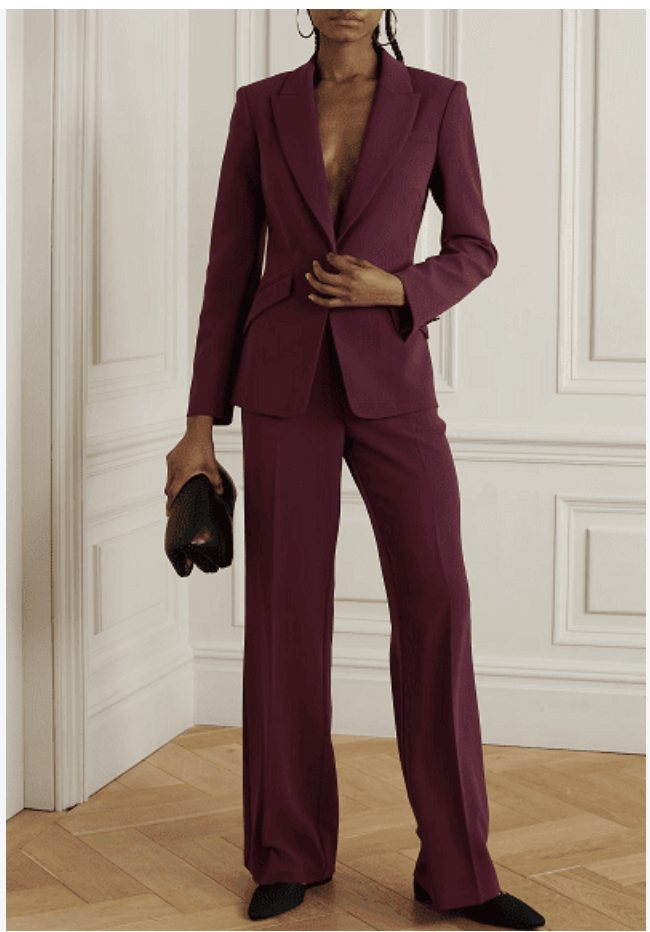
The suit on this month's page is Roland Mouret's burgundy wool crepe, with one button, a peak lapel and a long straight trouser. The jacket is about $950 and the trousers about $750. [Confirm style names and prices with the house.] Burgundy goes as far toward the season's red as a courtroom should, and on a woman at a lectern it reads as certainty, not mourning.
What to skip: Dior's ruffled minis, Chanel's iridescent tweeds, Louis Vuitton's large shoulders, and anything with a satin lapel, sequins or a slit.
On shoes, the jury consultants and the readers of Corporette agree on a polished flat or a low heel in good leather, slightly pointed, with no bow. A three-inch heel in a courthouse, one Connecticut lawyer wrote, "stand[s] out like a sore thumb." The Row's Pia pump, at $1,150, is the expensive version of that advice. Any good leather flat is the other.
His
The men's runway said a defined shoulder, a jacket long enough to cover the seat, straight or pleated trousers with a break, gray over everything, and pinstripes allowed again. The skinny suit, with its 2.5-inch lapel and jacket that stops at the belt, is dated.
The courtroom says the same, minus the pinstripe. A tailor who dresses lawyers wrote this spring that "solid charcoal gray is the undisputed champion for any trial attorney," that navy is the acceptable alternative, and that the single-breasted two-button is "the unimpeachable standard." The ABA Journal said it six years earlier: a solid dark suit and a white or blue shirt, because "the judge and jury want to know who is in charge."
This month's suit is Zegna's navy wool, with two buttons, a notch lapel, a soft shoulder and a trouser that breaks once. A Zegna merino twill two-piece is $4,950 at Mr Porter. [Confirm the fabric line and price with the house.] It is the suit a juror expects from a serious man, cut a size closer than his father wore it.
Prices read from retailer pages on Nov. 1 show what the shape costs at each level. Off the rack, Suitsupply's tropical wool suit is $548, J.Crew's Ludlow runs about $800 to $900 for jacket and trouser, and Polo Ralph Lauren is $998. The advice is to buy for the shoulders and neck and pay a tailor to take in the body and hem the trousers. At the designer level, Canali is about $3,420, Zegna $4,950 and Tom Ford $5,720 to $7,200, while Kiton and Brunello Cucinelli run $10,900 to $13,300.
Made to measure starts lower: Proper Cloth, $645 to $845, in under four weeks; Michael Andrews Bespoke in New York from $995; Balani in Chicago, $1,899 to $8,999 depending on cloth; and Hall Madden in Washington, women's suits from $1,250. At the bespoke end, Paolo Martorano in New York started at $7,500 as of 2022, a price that is probably higher now, and Huntsman on Savile Row starts at £7,500, with three fittings over four months.
A two-piece from The Row or Tom Ford costs about what a true bespoke suit costs. For a tall woman, a long-armed man or anyone whose body does not match a size chart, made-to-measure at $1,250 to $2,500 is the middle option, and it is the tier the fashion houses have no reason to promote.
Eight hours on your feet
A trial is standing up, and the tailors who think about this name two things besides price.
The first is cloth. They recommend a tropical or high-twist worsted, about 8 to 10 ounces, in a plain weave. Mr. Cundey said air moves through it and the yarn is "springy with high recovery," so a lawyer sitting down at 4 p.m. looks as she or he did standing up at 9. Suitsupply's $548 suit is tropical wool. Kiton's $10,890 suit is wool fresco, which serves the same purpose. The comfortable cloth and the price are separate decisions.
The second is the construction. Cheaper jackets glue a stiffener to the cloth; better ones float a canvas inside it, stitched by hand. A glued jacket is fine for a year, then bubbles and loses its shape. A canvased jacket rolls softly at the lapel and moves with the wearer for a decade. For a buyer who can afford one upgrade, this is the one.
Fit, cloth, canvas, then color. That order will put a lawyer in the courtroom looking like the person in charge, at $548 or at $7,500.
The tunnel walk
The best-dressed men in America on a Sunday are not on a runway. They are walking from a bus to a locker room.
This season, Dak Prescott wore a navy pinstripe with brown loafers to the Giants game. Jalen Hurts wore a beige double-breasted suit to Soldier Field. Patrick Mahomes wore a burgundy-and-cream pinstripe three-piece in Las Vegas, made by Stephen Richards Jr. of Richards Bespoke. The Steelers' quarterbacks arrived in Paris in matching three-piece suits and flat caps.
Two things stand out to a trial lawyer. The shape is the courtroom shape: built shoulder, long jacket, straight trouser. And little of it comes from Milan. The makers credited are American bespoke tailors who build for athletic bodies, the same kind of maker a lawyer in New York or Chicago can book.
Good for Jury
Starting this month, every suit the magazine shows gets a rating from one to five on three tests. Does it read expensive without saying so? Does it disappear, so the jury watches the lawyer's face? Can it be worn for eight hours standing? A five is a suit the wearer forgets. A one is a suit the jury remembers instead of the lawyer. The ratings will run with the photographs, and the price will be stated every time.
Prices read from retailer pages on Nov. 1, 2026; several maker prices are older and marked. Photographs courtesy of the houses named. [Photo credits and licenses to confirm before publication.] Nothing on this page is sponsored.
Sources
The Impression, Fall 2026 men's season overview, Feb. 6, 2026 · The Impression, Zegna Fall 2026, Jan. 15, 2026 · The Impression, Saint Laurent women's Fall 2026, Feb. 22, 2026 · Who What Wear, The Row Fall 2026, March 10, 2026 · Who What Wear, The Row prices, Aug. 9, 2026 · FashionUnited, Tom Ford, March 6, 2026 · Holland & Knight, "Getting Dressed for Court," Jan. 14, 2025 · ABA Journal, Jan. 16, 2020 · Oliver Wicks, trial suit guide, Feb. 25, 2026 · The Gentleman's Journal, Simon Cundey of Henry Poole · Corporette, Best Women's Suits of 2026 · Corporette, flats in court · ESPN, Week 1 arrivals, Sept. 13, 2026 · ESPN, Week 3, Sept. 28, 2026 · Andscape, October tunnel fits, Oct. 27, 2026 · Retailer prices: Suitsupply, J.Crew, Ralph Lauren, Mr Porter US, Mytheresa, Proper Cloth, Michael Andrews, Balani, Hall Madden, all read Nov. 1, 2026. Full notes: reports/Mens suits for trial lawyers.md and reports/Womens suits for trial lawyers.md